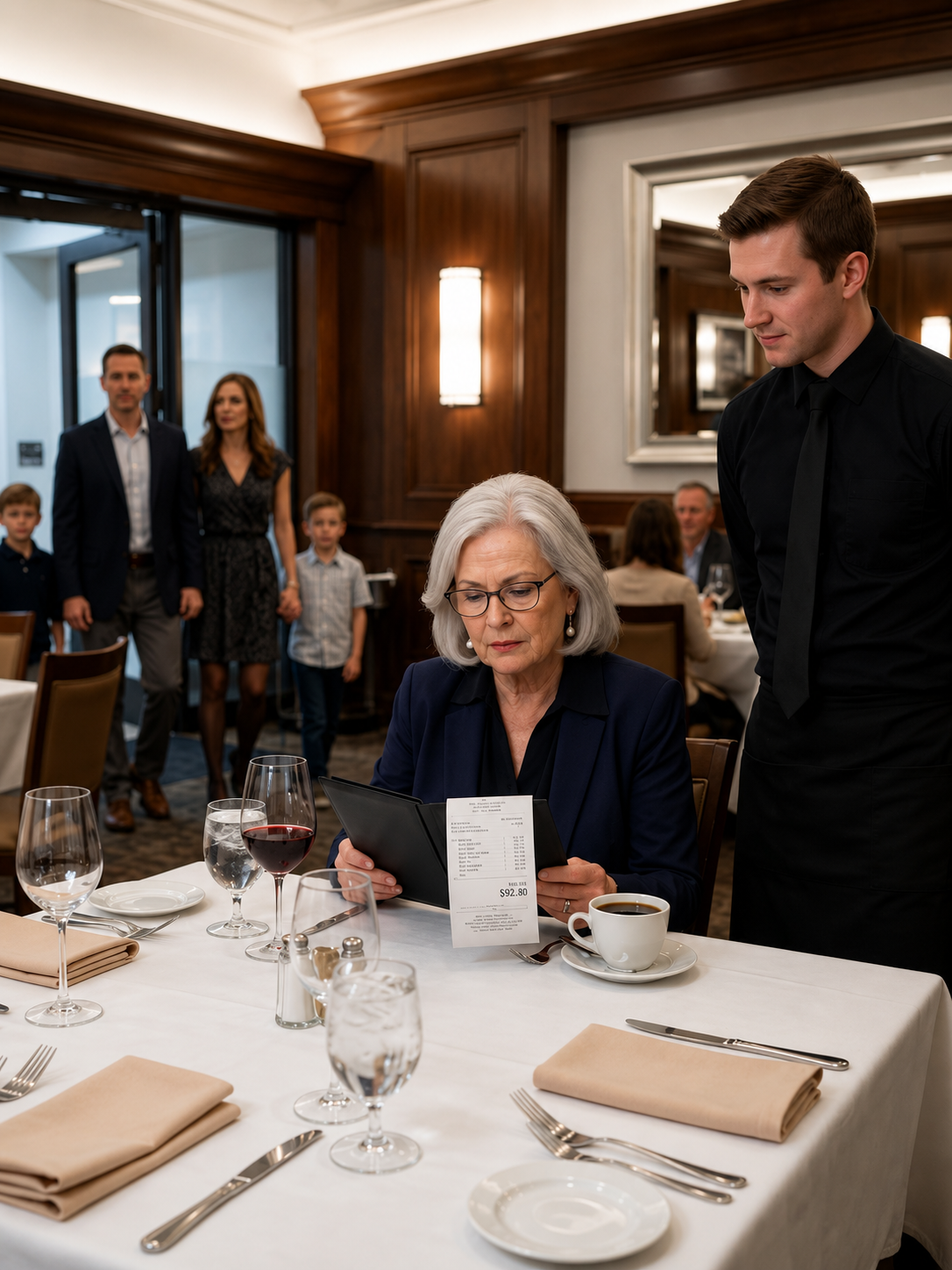
Margaret had spent forty years putting her family first. So when her son Daniel invited her to an elegant restaurant for her 70th birthday, she believed it was finally a sincere gesture of love.
Daniel arrived with his wife and children, ordered expensive food and champagne, and spent the evening smiling as if they were the perfect family.
Then his phone rang.
“Mom, I’ll be right back,” he said.
His wife gathered the children and followed him outside.
They never returned.
Twenty minutes later, the waiter approached Margaret with an uncomfortable expression and placed a $92.80 bill on the table.
“Your family left,” he whispered. “And your son said you needed to learn that family isn’t free.”
Margaret felt humiliated. Daniel knew she lived on a small pension.
But a man near the entrance had heard everything.
It was Richard Hale, the attorney who had handled her late husband’s estate.
“Mrs. Carter,” he said, placing a sealed envelope before her, “I’ve been trying to reach you. Your husband left the family house entirely in your name.”
Margaret stared at him in shock.
Richard explained that Daniel had hidden important documents and tried to pressure her into selling the property cheaply, hoping to take control of the money.
The next morning, Daniel rushed to Margaret’s house.
“Mom, please! Let me explain!”
But the locks had already been changed.
Margaret stood behind the window, calm for the first time in years. She had paid the restaurant bill herself, contacted the attorney, and secured everything her husband had left her.
Daniel had wanted to teach his mother a lesson.
Instead, he learned one:
Never mistake kindness for weakness.